Three Common Forms of Myrrh Used in Aromatherapy
Resin, Essential Oils, and Extractions
Megan Tiehes, CA
3/26/2026
Three Common Forms of Myrrh Used in Aromatherapy
Throughout history, myrrh has appeared in cultural, ceremonial, and aromatic traditions across many regions. It is found in 16 different verses of the King James Bible, and was one of the gifts given to Jesus by the wisemen of the east.
In modern aromatherapy use, myrrh is most often encountered in three primary forms. While they all come from the same plant source, they differ in how they are produced and in the type of product that results.
Form 1: Myrrh Resin
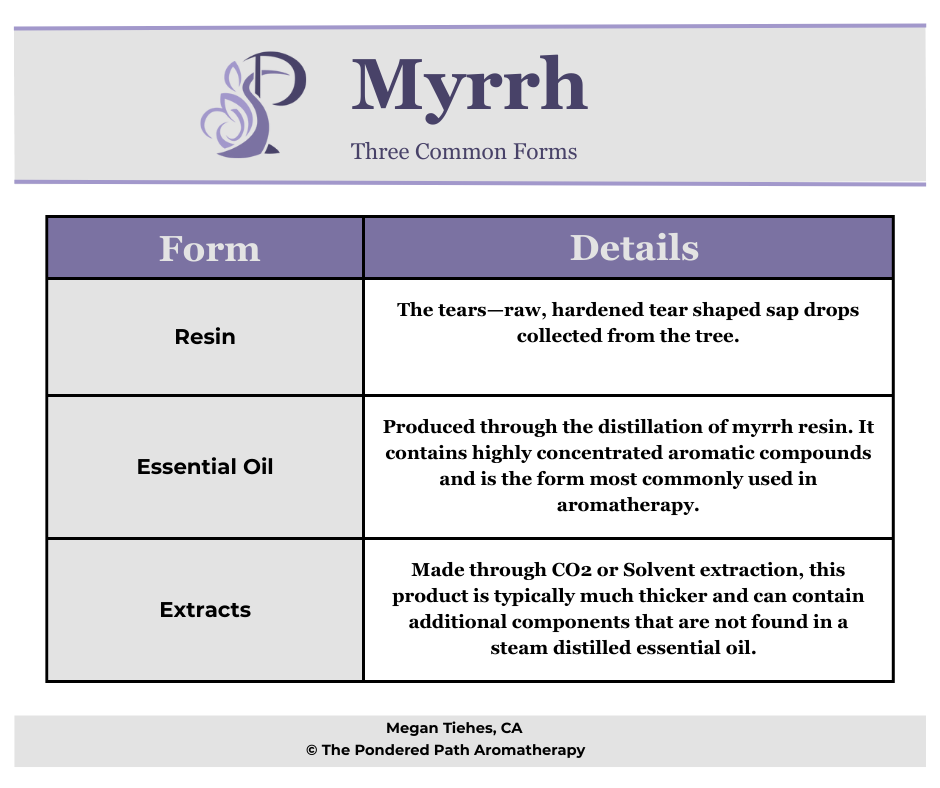
Myrrh resin refers to the raw, hardened, tear-shaped sap drops collected directly from the tree. These natural “tears” are formed when sap seeps from the tree and hardens upon exposure to air, creating the tear-like shapes.
This resin is the raw, unprocessed material from which the other two common forms are produced.
Form 2: Myrrh Essential Oil
Myrrh essential oil is produced through the distillation of myrrh resin. This process separates the volatile aromatic compounds from the resin, resulting in a highly concentrated essential oil.
This is the form most commonly used in aromatherapy.
Myrrh Extracts
Myrrh extracts are produced through either CO₂ extraction or solvent extraction methods. These products are typically much thicker than steam-distilled essential oils and can contain additional components that are not present in a steam-distilled essential oil.
CO₂ extraction uses pressurized carbon dioxide to extract aromatic compounds from the resin. When pressure is released, the carbon dioxide returns to a gaseous state and fully dissipates, leaving no solvent residue behind.
Solvent extraction, on the other hand, uses chemical solvents—commonly hexane—to extract compounds from plant material. Although the solvent is later removed, there is concern regarding the potential for residual solvent compounds, some of which are classified as carcinogenic, to remain in the final product. Due to this concern, solvent-extracted products are not recommended by many aromatherapists, including The Pondered Path Aromatherapy, and are often avoided in aromatherapy use.
Note: Extracts are not actually essential oils; however, some extracts are sold alongside essential oils because the plant material of certain plants is not suitable for distillation.
© 2025. All rights reserved.