
Speed? Inhalation for the Win
Megan Tiehes, Certified Professional Aromatherapist
6/16/2026

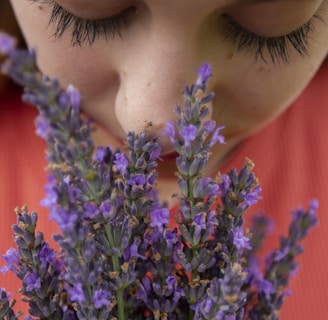
Do you know the fastest way for essential oils to enter the body?
Do you understand the mechanisms behind it?
Over the last 10 or 11 years, my experiences with essential oils and the Aromatherapy field in general, has left me with the realization that not everyone who claims to be an aromatherapist has undergone any form of professional aromatherapy education. Many make the claim based off of information they have learned through their Essential Oil MLM uplines and company representatives. Unfortunately, this practice has left a large gap, especially in the way of safety, when it comes to both using the oils and making claims about the oils and how best to use them.
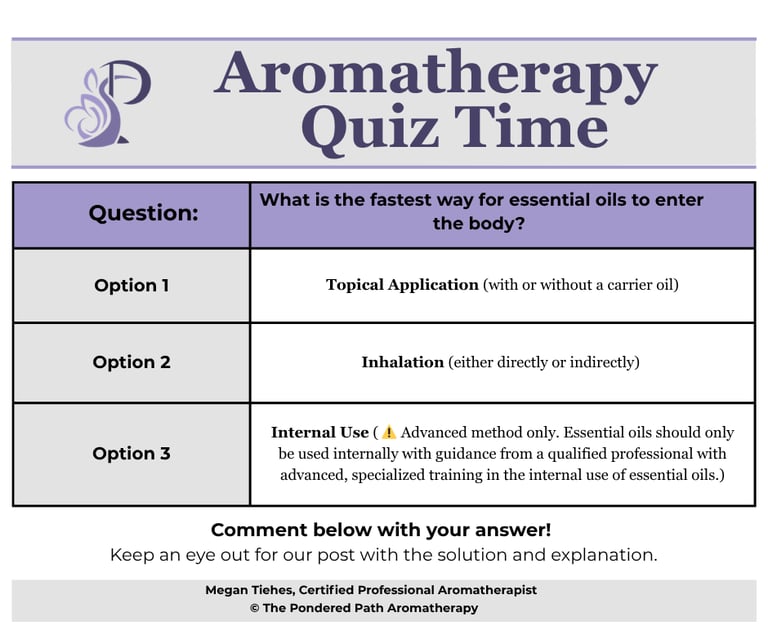
As I was reading Jane Buckle's book, Clinical Aromatherapy: Essential Oils in Healthcare, I came up with the idea: I would send out a one question quiz asking people what they think the fastest way of getting essential oils into the body is. I created the quiz and posted to a few social media accounts. Here is the post:
Within a relatively short time, I received my first reply. And guess what. The answer they gave was incorrect. Many people avoided give a response, perhaps out of a fear of getting the answer wrong. I also posted my little quiz into a group that is limited to practicing Aromatherapists who have received a formal Aromatherapy education and credentials of some sort. Every reply in this group was, as expected, correct. I do not state all this to condemn others, but to point out a pattern that I have observed within the aromatherapy culture. To the trained aromatherapist, the quiz as a simple question, with an answer that is basic, but valuable to understand. To the untrained, the information may be interesting, but without further explanation, they may not understand the true value it holds.
At the Pondered Path Aromatherapy, we are seeking to make aromatherapy more approachable—not for the formally educated, but for the everyday essential oil users and anyone seeking to learn about and better understand the safety, science, and applications of essential oils and aromatherapy. This blog post is written as a part of achieving that goal.
So, what is the answer that was so obvious to formally educated Aromatherapist, but eluded or was completely avoided by others?
Within a relatively short time, I received my first reply. And guess what. The answer they gave was incorrect. Many people avoided give a response, perhaps out of a fear of getting the answer wrong. I also posted my little quiz into a group that is limited to practicing Aromatherapists who have received a formal Aromatherapy education and credentials of some sort. Every reply in this group was, as expected, correct. I do not state all this to condemn others, but to point out a pattern that I have observed within the aromatherapy culture. To the trained aromatherapist, the quiz as a simple question, with an answer that is basic, but valuable to understand. To the untrained, the information may be interesting, but without further explanation, they may not understand the true value it holds.
At the Pondered Path Aromatherapy, we are seeking to make aromatherapy more approachable—not for the formally educated, but for the everyday essential oil users and anyone seeking to learn about and better understand the safety, science, and applications of essential oils and aromatherapy. This blog post is written as a part of achieving that goal.
So, what is the answer that was so obvious to formally educated Aromatherapist, but eluded or was completely avoided by others?
Inhalation!
"Inhaling essential oils is the fastest method of getting essential oils into the body."
— Jane Buckle, Ph.D., RN — Clinical Aromatherapy: Essential Oils in Healthcare, (3rd Ed.), p.21
What makes inhalation so remarkably fast and what value does this information hold?
At its simplest, the answer lies in two simultaneous and highly efficient physiological pathways.
The Olfactory Pathway
When we breathe in an essential oil, the aromatic molecules bind to specialized receptors of the olfactory epithelium. These receptors send signals to the olfactory bulb, which then relays them to other structures in the brain that identify the scent and produce chemical responses with pathophysiological effects. The limbic system is the region of the brain responsible for memory, emotion, and autonomic physiological responses. This pathway from nostril to the limbic system is uniquely direct, because, unlike most sensory information (i.e., sight, touch, hearing), olfactory signals bypass the thalamus entirely, which is why the brain's response to inhaled aromatic molecules is both immediate and powerful.
It is important to note that the essential oil molecules themselves do not enter the brain during inhalation — rather, it is the chemical response triggered when those molecules bind to the olfactory receptors that ultimately produces the effect.
The Pulmonary Pathway
Simultaneously, inhaled essential oil constituents travel down into the lungs and through increasingly fine bronchioles until they reach the alveoli — the microscopic air sacs deep within the lungs where gaseous exchange occurs. Because essential oil constituents are naturally very small volatile molecules, they are able to cross the thin alveolar membrane and enter the bloodstream— giving inhaled essential oils remarkably fast access to the entire body.
How does this compare to the other methods?
Topical application is an effective and widely used method, however dermal absorption is significantly slower — the skin is a protective barrier by design. The presence of a carrier oil slows penetration further—with some carriers slowing absorption more than others.
Internal use is a legitimate clinical method when administered appropriately, however absorption speed and therapeutic outcome vary considerably depending on the method of administration and the metabolic processes involved. Metabolism in particular can alter the chemical composition of essential oil constituents, which may influence their therapeutic efficacy. Internal use should only be considered under the guidance of a qualified professional with advanced, specialized training in the internal use of essential oils.
What are the methods of inhalation used in Aromatherapy?
Inhalation can be achieved through several methods, each with its own appropriate use and considerations:
Direct Inhalation involves breathing the aroma directly from the bottle, a tissue, personal inhaler, cupped hands, or steam inhalation. This method delivers aromatic molecules quickly and is well suited for immediate personal use, however it is generally recommended for short durations only.
Personal Inhalers are small portable devices containing an absorbent wick into which essential oils have been applied. Personal inhalers offer a controlled and convenient form of direct inhalation and are particularly useful for targeted therapeutic support throughout the day. This is one of my favorite ways of using and inhaling essential oils.
Steam Inhalation involves adding essential oils to a bowl of steaming water and inhaling the vapors, often with a towel draped over the head to concentrate the steam. This is a traditional and effective form of direct inhalation, particularly for respiratory support. This method comes with its own set of safety considerations and should be used with caution—it is not appropriate for all individuals or all essential oils.
Indirect Inhalation involves dispersing essential oil molecules into the surrounding air, creating ambient inhalation for everyone in the space. Diffusion is one of the most widely used methods of indirect inhalation in aromatherapy practice. There are several types of diffusers available, each operating differently in terms of how they disperse the oils.Before purchasing a diffuser, I suggest reading up on the various options to be sure you have what you are hoping for.
Incidental Inhalation occurs when inhalation is not the primary intended method of application. When we dilute an oil and apply it to our skin, we are still inhaling some of the aromatic molecules, though inhalation may not have been the intended method of interacting with the essential oil. Because inhalation interacts with the body so quickly — through the bloodstream and multiple physiological responses (emotions, memory recall, focus, relaxation, etc.) — incidental inhalation can bring a wonderful added benefit when it comes to the overall support of the body's natural processes through the use of essential oils and aromatherapy products.
Safety matters!
Inhalation Safety Considerations
While inhalation is generally considered the gentlest method of aromatherapy application, it is not without its own safety considerations. Responsible practice requires awareness of the following:
Duration of exposure matters significantly. Prolonged or continuous exposure to diffused essential oils can cause headaches, nausea, or sensitization over time. It is generally recommended to diffuse intermittently rather than continuously. For adults, this is typically 30 to 60 minutes on followed by a break — rather than running a diffuser continuously throughout the day. The smaller the space, the shorter the duration should be.
Respiratory conditions require particular caution. Individuals with asthma, chronic obstructive pulmonary disease, migraines, chemical sensitivities, allergies, or other respiratory sensitivities may find that certain essential oils trigger or aggravate symptoms. Care and professional guidance are advised for this population.
Young children and infants have smaller, more sensitive respiratory systems and metabolize essential oil constituents differently than adults. Extra caution is warranted, and certain oils are contraindicated entirely for young children and infants. When diffusing, it is suggested to limit the exposure to 10-15 minutes on followed by a 30-minute break. Some diffusers have built in timers for intermittent diffusing that can be very helpful. A child’s proximity to the diffuser should also be considered—depending on factors such as age, health, and especially the specific oil and the particular constituents it contains.
Pets are especially vulnerable to inhaled essential oils, particularly cats, birds, and small animals. Diffusing essential oils in spaces shared with pets should be approached with great care. Make sure your pets can leave the space should they desire to. Working with and receiving guidance from a veterinarian or specifically trained aromatherapist knowledgeable in essential oil safety with pets is suggested.
Pregnancy and breastfeeding are further considerations to be aware of. Certain essential oils are contraindicated during pregnancy regardless of the method of application, including inhalation. Essential oil constituents are likely to cross the placenta efficiently due to their low molecular weight and lipophilic nature. While crossing the placenta does not automatically indicate a hazard — as risk depends on the specific constituents, their toxicity, and plasma concentration — caution during the first trimester is strongly advised, as this is the most critical period of fetal development. For this reason, many practitioners recommend limiting or avoiding essential oil usage during the first trimester entirely. Robert Tisserand and Rodney Young's Essential Oil Safety provides a comprehensive list of oils contraindicated during pregnancy and breastfeeding and is an excellent resource for navigating this topic safely.
Inhalation can be a beautiful and beneficial way to work with essential oils. These considerations are not intended to discourage the use of inhalation as a method — rather they reflect the importance of approaching aromatherapy with the same respect and diligence we should apply to any highly concentrated substance, even in the case of natural substances—like essential oils.
📚 Sources:
Buckle, J. (2015). Clinical aromatherapy: Essential oils in healthcare (3rd ed.). Elsevier.
National Association for Holistic Aromatherapy. (2017). The nasal inhaler: Aromatherapy's unsung hero. https://naha.org/naha-blog/the-nasal-inhaler-aromatherapys-unsung-hero/
Tisserand, R. (n.d.). Safety guidelines. Tisserand Institute. https://tisserandinstitute.org/safety-guidelines/
Tisserand, R., & Young, R. (2014). Essential oil safety: A guide for health care professionals (2nd ed.). Churchill Livingstone.
Toudou Daouda, M., Tanko, Y., Mahamane Moustapha, A., & Mahamadou, A. (2022). Inhalation aromatherapy via brain-targeted nasal delivery: Natural volatiles or essential oils on mood disorders. Frontiers in Psychiatry, 13, 863043. https://www.ncbi.nlm.nih.gov/pmc/articles/PMC9041268/
© 2025. All rights reserved.